
The Clock
Statement of the Board, 2026
The Bulletin of the Atomic Fiscal Scientists · Helsinki Bureau · Penguin Space
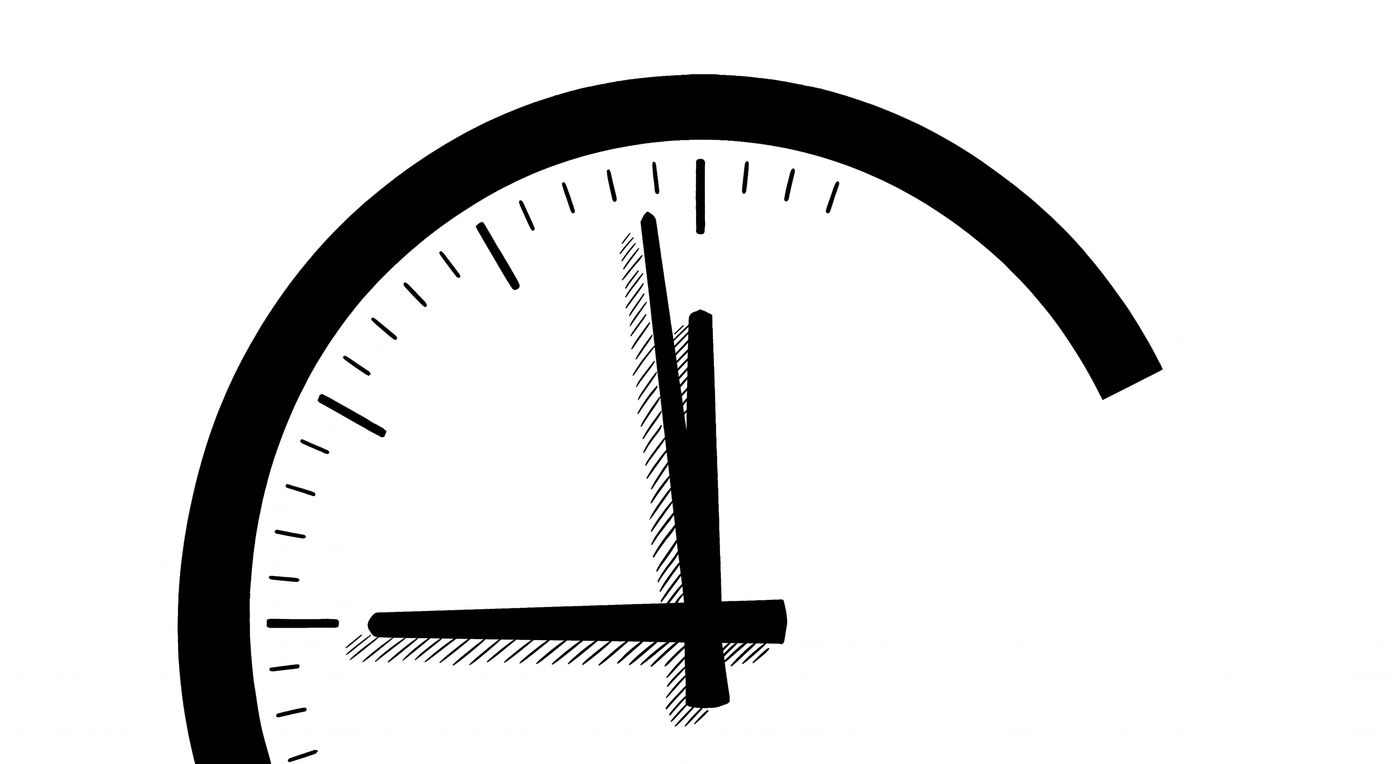
The Board of the Bulletin of the Atomic Fiscal Scientists issues this statement in support of its setting of the Clock at eleven cents to midnight.
Midnight is June 30. It is always June 30. The Board has been asked repeatedly to move it and declines, on the grounds that the state of Rhode Island has already fixed the date and the Board is not in the business of improving on statute.
What follows is the evidence.
I. Interest
The federal government will spend approximately one trillion dollars servicing its debt in fiscal 2026. This is not a forecast. It is a run rate, visible monthly.
It exceeds what the government will spend on national defense. It exceeds what it will spend on Medicaid. At 3.3 percent of gross domestic product it is the highest share since 1991, and the Congressional Budget Office projects it will reach 4.6 percent by 2036, at which point the annual figure is $2.1 trillion. Over the coming decade, interest alone totals $16.2 trillion.
The Board notes that interest is the only line in the budget that nobody voted for, nobody administers, and nobody can cut. It is what a decision looks like once it has finished being a decision.
Debt held by the public stands at roughly 101 percent of GDP, the highest since the Second World War. CBO projects 120 percent by 2036.
The Board draws no conclusion from these figures beyond the one they contain.
II. The Pension
Providence's retirement system closed fiscal 2025 at 31.4 percent funded. The city holds $582 million against $1.85 billion in obligations.
The national median for public pension systems is 77.8 percent. The hundred largest plans in the country averaged 83.7 percent at the end of March. Providence is not near the bottom of a distribution. Providence is the reason the distribution has a tail.
Nearly a third of the city's tax levy is committed to the pension before any other spending decision is made. The annual payment is $118 million now and is scheduled to reach $224 million by 2040, the year the system is projected to reach full funding.
The Board wishes to be precise about what that schedule means. It does not mean the problem is being solved in 2040. It means the problem has been assigned to 2040. Every intervening year is a year in which someone must make the payment and receive nothing visible in exchange, and the Board observes that snow removal, road surface and school condition are all downstream of a decision made before most current taxpayers arrived.
III. The Out-Years
Rhode Island's enacted fiscal 2027 budget is balanced. The constitution requires it.
The Fiscal Staff estimates a gap of approximately $260 million in fiscal 2028, growing to approximately $420 million by fiscal 2031. The Office of Management and Budget, working from the Governor's proposal, put the same figures at $237.4 million and $537.0 million.
State general revenue spending is projected to rise from $5.95 billion to roughly $6.9 billion over that span — a 16 percent increase. Revenue is projected to grow at about half that rate.
The Board has reviewed the arithmetic and finds it correct. Two lines diverging is not a crisis. It is a graph. The crisis is the year the graph is read aloud.
IV. What is not in the Clock
The Board is obliged to state what it has excluded.
The Clock does not price political will, because the Bureau's scientific staff cannot agree on its units. It does not price federal action, which the Board regards as weather rather than climate. It does not price the possibility that someone simply pays.
Nor does the Clock measure suffering. It measures distance from a date. The Board is aware that these are different quantities and that the second is easier to publish.
V. The methodology, restated
The Bureau's method is the huddle. The colony rotates continuously so that no penguin stands on the outside longer than it can afford. The rotation is the entire science.
The cold is not distributed by the cold. It is distributed by the formation.
Applied to a municipal balance sheet, the finding is unremarkable and holds anyway: the obligation is fixed, the question is only who is standing where when it comes due, and a formation that stops rotating has not reduced the cold. It has selected someone.
Dissents, printed in full
Koala Smolin, financial physicist
There is no time. The parameter does not appear in the equations. The dynamics are all present; the clock is not among them.
Koala Rovelli, financial physicist
Time exists when things are warm. In a cold market there is no time to report, which is not the same as saying nothing is wrong.
Koala Deutsch, financial physicist
I decline the premise from the other side. Nothing that is not forbidden by the laws of physics is inevitable, including this. There is no reason midnight has to happen.
The Board thanks its staff for their objections, which it has printed, and overruled, in cents.
**Sources.** Federal interest and debt figures: Congressional Budget Office, Budget and Economic Outlook, February 2026; Peter G. Peterson Foundation interest tracker. Providence pension figures: City of Providence actuarial valuation, fiscal year ended June 30, 2025, as reported by the Boston Globe, February 2026. National pension medians: NASRA Public Fund Survey; Milliman 100 Public Pension Funding Index, March 2026. Rhode Island out-year projections: House Fiscal Advisory Staff, FY2027 Budget as Enacted; Rhode Island Office of Management and Budget; Rhode Island Public Expenditure Council, January 2026.
It Is Eleven Cents to Midnight · Statement of the Board · Helsinki Bureau · Penguin Space